Stroke Rehabilitation in Erode: Recovery Care and Therapies
Looking for trusted stroke rehabilitation in Erode? Sugam Wellness Centre combines physiotherapy, hydrotherapy, massage and guided yoga to help stroke survivors regain movement, balance and confidence at an affordable cost.
Understanding Stroke Rehabilitation in Erode
A stroke happens when blood supply to part of the brain is interrupted, and the damage can affect movement, speech, vision, memory and emotions. Rehabilitation is the structured process that helps the brain and body relearn lost skills. Stroke rehabilitation in Erode is now available close to home, so families no longer need to travel to big cities for every session.
Good rehabilitation is not a single exercise or machine. It is a team approach where therapists, doctors, caregivers and the survivor work toward clear goals such as walking safely, using the hand again, eating independently and returning to daily routines. At Sugam Wellness Centre, every programme begins with a careful assessment so that therapy matches the person, not the other way around.
Because the brain can form new connections through repetition, regular and well-guided practice makes a real difference. That is why a dedicated stroke recovery centre with a calm environment, trained hands and a daily routine often delivers better progress than scattered home attempts.
Rehabilitation usually continues in phases: hospital care first, then structured therapy at a centre, and finally long-term practice at home. A good plan connects all three phases so nothing is lost along the way.
Why Early Recovery Care Matters
The first weeks and months after a stroke are often called the golden window, because the brain is most responsive to therapy during this period. Starting stroke rehabilitation in Erode early can reduce stiffness, prevent muscle shortening and protect against complications such as shoulder pain and pressure sores.
Early work also protects emotional health. Many survivors feel frustrated, anxious or low when they cannot do simple tasks. Small wins in therapy, such as standing for one minute longer, rebuild hope. Families who begin recovery care quickly usually feel more informed and less helpless.
That said, it is never too late to begin. Survivors who are months or even years past their stroke can still gain strength, flexibility and independence, and stroke rehabilitation in Erode is designed to welcome them at any stage.
Types of Stroke and Their Effect on Recovery
Doctors describe three main situations. An ischemic stroke occurs when a clot blocks an artery, and it is the most common type. A haemorrhagic stroke happens when a blood vessel bursts and bleeds into or around the brain. A transient ischemic attack, often called a mini-stroke, causes temporary symptoms but is a serious warning sign.
The type, the area of the brain affected and the time taken to receive hospital care all influence recovery. A stroke on the left side of the brain commonly affects the right side of the body and may involve speech, while a right-sided stroke can affect left-side movement, attention and spatial awareness. Understanding this helps therapists choose suitable exercises and helps families set realistic expectations.
Whatever the type, the rehabilitation principles remain similar: begin when medically safe, practise often, increase difficulty slowly and keep the survivor motivated.
Our Approach to Stroke Rehabilitation in Erode
Our approach blends modern physiotherapy with natural healing methods. Instead of relying only on medicines, we focus on movement, water, touch, breath and routine. This is how we deliver stroke rehabilitation in Erode that feels gentle yet effective.
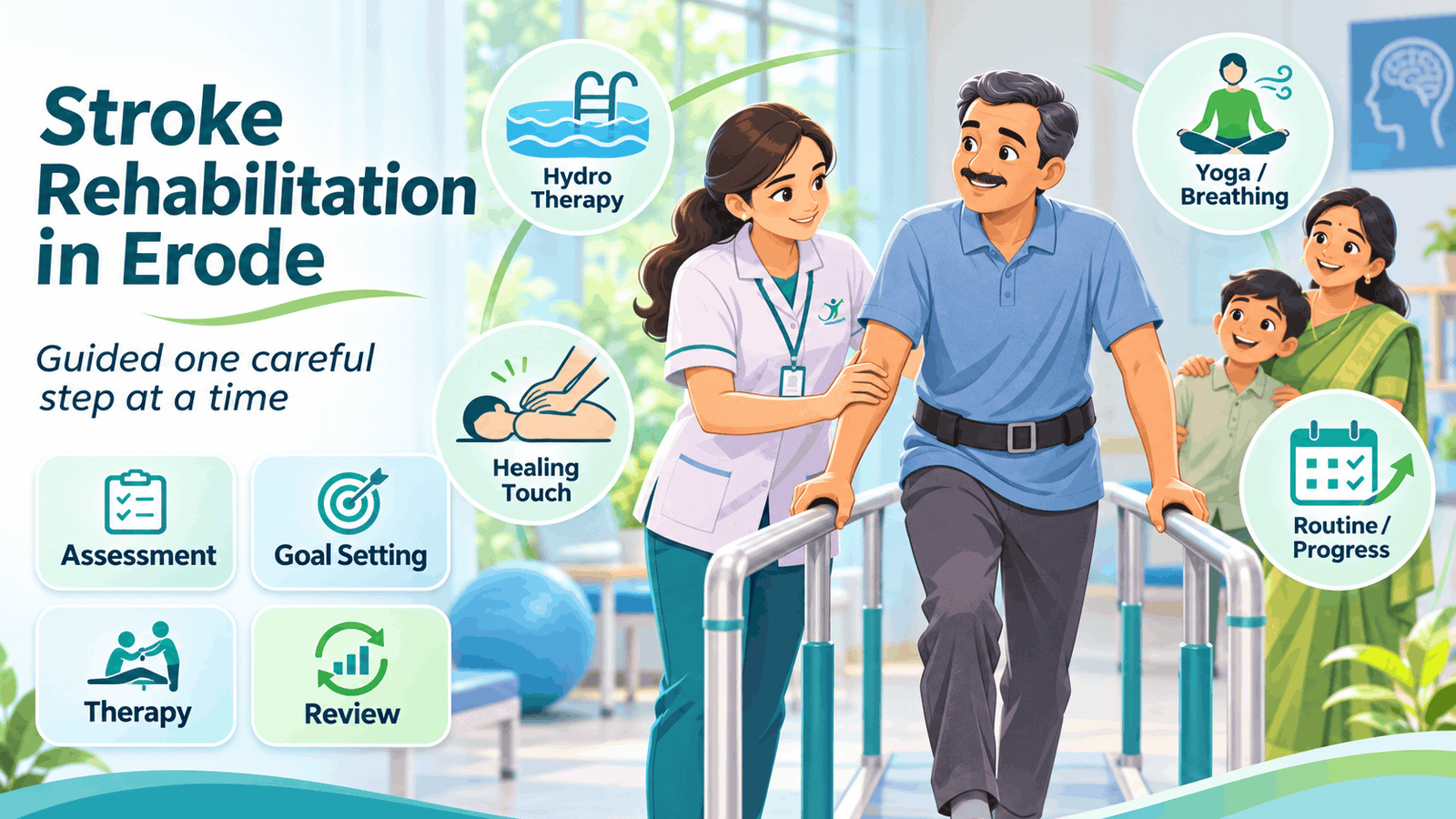
Assessment
A detailed review of strength, balance, speech needs and daily activity limits.
Goal setting
Short and long-term goals agreed with the survivor and family.
Therapy
Daily sessions combining physiotherapy, water therapy, massage and yoga.
Review
Regular progress checks and honest changes to the plan.
Common Problems After a Stroke
Every stroke is different, but several challenges appear again and again. Recognising them helps families plan the right therapy.
- Weakness or paralysis on one side of the body
- Stiff muscles, spasticity and painful shoulders
- Poor balance and fear of falling
- Difficulty with speech, swallowing or memory
- Fatigue, low mood and sleep problems
Stroke rehabilitation in Erode works best when the whole person is treated. Moving the arm is important, but so are sleep, nutrition, confidence and family support.
Post Stroke Physiotherapy Erode Families Can Rely On
Post stroke physiotherapy Erode patients receive at Sugam is built around active, goal-based movement. Our physiotherapy team works on gentle range-of-motion exercises, strengthening, stretching, transfers from bed to chair, standing practice and gait training.
Post stroke physiotherapy Erode survivors choose should be repeated, comfortable and progressive. We begin with simple tasks such as weight shifting and sitting balance, then move to supported standing, walking with aids and finally stairs and uneven surfaces. Each stage is only advanced when the person is ready.
Sessions are usually short and frequent, because tired muscles learn poorly. Therapists watch for pain, dizziness and fatigue, and they adjust the plan during the session itself. Simple tools such as parallel bars, balance boards, therapy balls and resistance bands keep exercises safe and engaging.
- Range-of-motion and stretching to prevent stiff joints
- Strengthening of the weaker arm and leg
- Sitting and standing balance training
- Gait training with walkers, sticks or support
- Hand and finger function practice
Regular post stroke physiotherapy Erode families can access locally also teaches caregivers how to assist safely at home, which keeps progress going between visits.
Paralysis Treatment Erode: Regaining Movement Step by Step
Paralysis after a stroke usually affects one side of the body, known as hemiplegia. Paralysis treatment Erode patients seek is rarely about a quick fix; it is about steady retraining of the brain and muscles.
Our paralysis treatment Erode programme uses positioning, passive movement, assisted active exercise, task practice and hand-function training. Therapists encourage the weaker limb to take part in everyday actions, because use creates recovery.
Safe, patient paralysis treatment Erode families trust also includes pain control, skin care, correct sitting posture and support advice where needed. Results vary from person to person, and we are honest about realistic goals from the very first visit.
Many families ask whether movement will return fully. Honestly, recovery depends on the brain area affected and how early and regularly therapy happens. What we promise is careful, respectful effort and clear communication. Even small gains in grip or leg control can change daily life dramatically.
Therapies Included in Our Recovery Programme
Physiotherapy
Strength, balance, walking and joint mobility training with progressive goals.
Hydrotherapy
Warm-water treatments that relax muscles and ease painful stiffness.
Aqua therapy
Supported exercise in water for confident standing and stepping.
Massage
Gentle pressure on muscles and fascia to reduce tightness and aid relaxation.
Reflexology
Focused foot and hand pressure that supports comfort, circulation and sleep.
Yoga and breathing
Seated and supported postures that improve posture, calm and flexibility.
Hydrotherapy, Massage and Yoga for Stroke Recovery
Water is one of the kindest tools for rehabilitation. In warm water, the body feels lighter, so weak limbs can move with less effort and less pain. Aqua therapy and hydrotherapy at Sugam help survivors practise standing, stepping and arm movements with confidence.
Therapeutic massage eases tight muscles and improves comfort, while reflexology and relaxing touch can support better sleep and reduce stress. Gentle yoga and breathing exercises improve posture, flexibility and calm. Together these methods make stroke rehabilitation in Erode more complete and more enjoyable.
All natural therapies are offered alongside, not instead of, your neurologist's treatment and prescribed medicines.
Nutrition and Lifestyle Support After a Stroke
Food and lifestyle are powerful partners of therapy. A balanced, low-salt diet rich in vegetables, fruits, whole grains, pulses and healthy fats supports blood pressure, blood sugar and heart health. Our naturopathy consultation guides families on simple, home-friendly meal choices without extreme restrictions.
Hydration, regular sleep, stress control and a gentle walking habit are equally important. Survivors who swallow with difficulty should follow the doctor's advice on food texture, and we encourage families to seek medical guidance before changing any diet.
Quitting tobacco and limiting alcohol also lower the risk of another stroke. Small, consistent changes are easier to maintain than dramatic ones.
A Peaceful Stroke Recovery Centre Close to Home
Environment matters. Our stroke recovery centre offers a green, quiet setting with a walking track, outdoor gym, garden, indoor games and comfortable stay rooms for those who need daily sessions.
Healthy meals, supportive staff and a relaxed routine make the stroke recovery centre experience far less stressful than a hospital ward. Survivors who live outside Erode can stay on site and focus fully on therapy.
Fresh air, social interaction and light activity in the garden also lift mood, which is an important part of stroke rehabilitation in Erode.
Stroke Rehabilitation in Erode: A Typical Recovery Journey
- Week 1: Consultation and assessmentMedical reports are reviewed, and baseline strength, balance and daily activity are recorded.
- Weeks 2 to 4: FoundationPain relief, gentle mobility, positioning and hydrotherapy begin.
- Months 2 to 3: StrengtheningStanding, walking practice, hand tasks and yoga-based balance work increase.
- Month 3 onward: IndependenceHome exercise plans, family training and return-to-routine goals take priority.
Timelines vary. Some survivors progress quickly, while others need longer, and both journeys are valid.
How to Prepare for Your First Visit
Bring discharge summaries, scan reports, a list of current medicines and any recent blood pressure or sugar readings. If the survivor uses a walking stick, walker or wheelchair, bring it along so the therapist can see how movement works in daily life.
Wear loose, comfortable clothing and flat shoes. A family member or caregiver should attend the first session, because their observations about sleep, appetite, mood and daily struggles help us design better stroke rehabilitation in Erode for that individual.
You are welcome to ask questions about timelines, cost, therapy hours and home exercises. We would rather answer every doubt openly than leave a family guessing, because trust and clarity make recovery easier for everyone involved.
Myths and Facts About Stroke Recovery
Myth: Recovery stops after six months.
Fact: Many people keep improving for years when they continue to practise.
Myth: Rest is the best medicine.
Fact: Too much rest causes stiffness; guided movement is safer and more effective.
Myth: Paralysis is always permanent.
Fact: Outcomes vary, and many survivors regain useful movement with consistent therapy.
Myth: Only elderly people have strokes.
Fact: Younger adults can be affected, especially with high blood pressure, diabetes or smoking.
How Families Can Support Stroke Rehabilitation in Erode
Family involvement is one of the strongest predictors of good recovery. Simple habits help:
- Encourage use of the weaker side during daily tasks
- Keep a regular sleep, meal and exercise routine
- Celebrate small improvements and avoid comparisons
- Never skip medicines, blood pressure or sugar checks
- Prevent falls by removing loose mats and improving lighting
Caregivers also need rest. Burnout is common, so share duties and ask the therapy team for guidance whenever you feel unsure.
Why Choose Sugam Wellness Centre for Stroke Rehabilitation in Erode?
Personalised plans
No copy-paste routines; every plan is built around the survivor.
Physiotherapy and natural care
Post stroke physiotherapy Erode families need, with water therapy, massage and yoga under one roof.
Honest guidance
Clear goals for paralysis treatment Erode survivors can understand and measure.
Stay-in comfort
Rooms, meals and a garden at our stroke recovery centre.
Led by Dr Vanathi Sethupathi
Naturopathy guidance with a caring, patient-first outlook.
Affordable care
Wellness services made accessible beyond big cities.
Our mission is to make accessible and affordable wellness services available beyond big cities, which is why stroke rehabilitation in Erode at Sugam focuses on honest guidance and long-term support rather than quick promises. Learn more about every programme on sugam.life.
📍 110, KTK Thangamani Street, Loganathapuram, Kollampalayam, Erode 638002
Frequently Asked Questions About Stroke Rehabilitation in Erode
How long does stroke rehabilitation in Erode take?
Recovery time depends on the stroke's severity, age, overall health and how early therapy begins. Many people see steady gains over the first three to six months, and improvement can continue for a year or longer with regular practice.
Can a person fully recover from a stroke?
Some survivors recover most of their abilities, while others regain partial function. Rehabilitation aims to maximise independence, comfort and quality of life, whatever the starting point.
Is physiotherapy helpful after a stroke?
Yes. Post stroke physiotherapy Erode survivors receive helps improve strength, balance, walking and joint movement, and prevents stiffness. It works best when started early and practised regularly.
What is the best treatment for paralysis after a stroke?
There is no single best option. Effective paralysis treatment Erode programmes combine physiotherapy, task practice, water therapy, positioning and family training, guided by your doctor.
When should rehabilitation start?
As soon as the doctor confirms the person is medically stable, often within days of the stroke. Starting stroke rehabilitation in Erode early gives the brain the best chance to adapt.
Can stroke patients walk again?
Many can, with or without a walking aid, depending on the severity and consistency of therapy. Gait training, balance work and strengthening are the main tools.
What are the early warning signs of a stroke?
Remember FAST: Face drooping, Arm weakness, Speech difficulty and Time to call emergency services immediately. Sudden numbness, confusion, vision loss or a severe headache also need urgent hospital care.
Do I need to stay at the centre for therapy?
Not always. Many people attend daily or alternate-day sessions from home, while those travelling from other towns can use our stay rooms at our stroke recovery centre.
What can I do to prevent another stroke?
Control blood pressure, sugar and cholesterol, stay active, avoid tobacco, eat a balanced diet and take medicines as advised. Our team can guide lifestyle changes.
Begin Your Stroke Rehabilitation in Erode Today
Every day of consistent therapy brings a survivor closer to independence. Call or message Sugam Wellness Centre to book your assessment and take the first step toward recovery with a caring stroke recovery centre team.